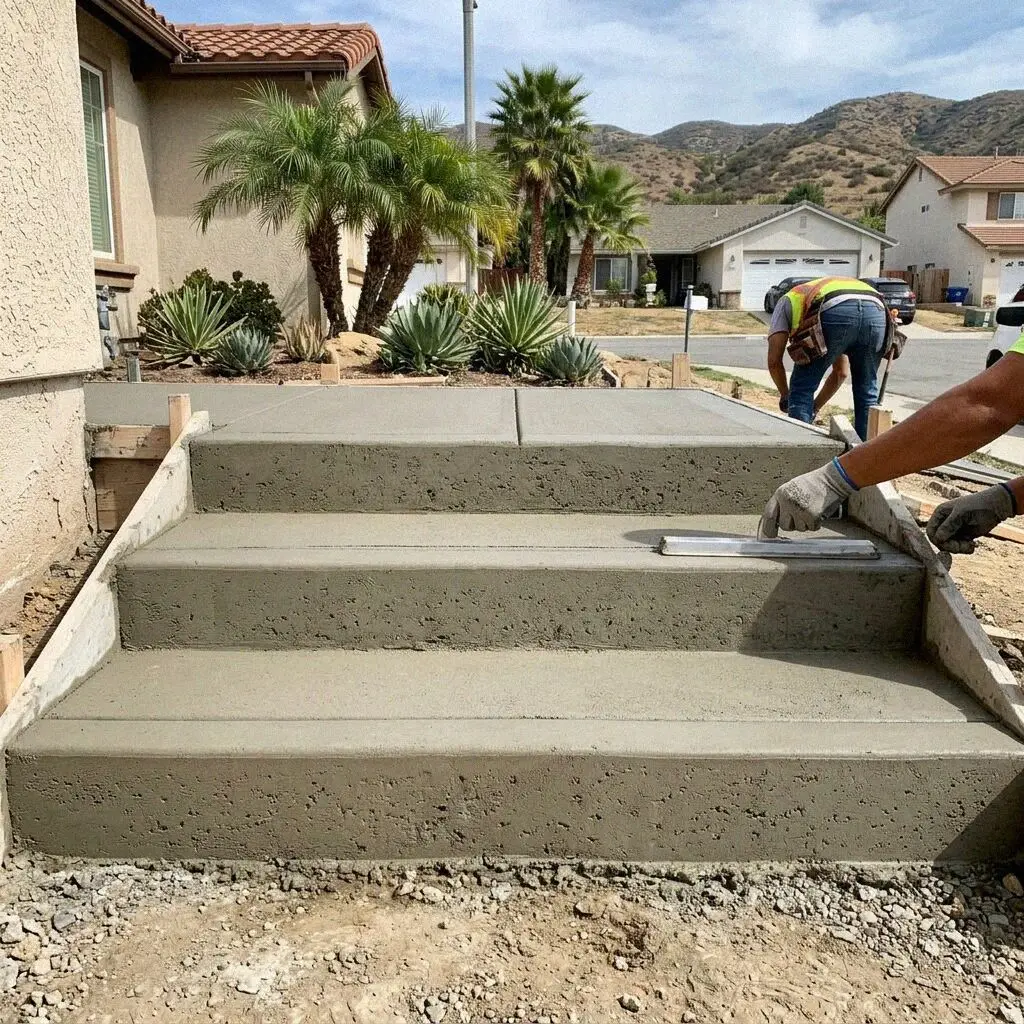
A flight of steps is judged by the feet that do not know it, and in Costa Mesa most of the feet on a step belong to a tenant, a visitor or a delivery driver not the person who paid for it. Nobody learns a step they use once, so a riser taller than the one below it, or a tread that is slick on a gray morning, is a fall waiting for the next stranger. So every riser is poured within three eighths of an inch of the others, every tread is broomed, and the top step meets the sill level.
Harbor Costa Mesa Concrete was founded in 2019 by Julian Mercado, who put 15 years into flatwork across coastal Orange County first, and he sets the riser heights himself. Most of the housing here went up between the 1950s and the 1970s, on slabs, so a front door stands one or two risers over the walk and a fourplex has a stoop at every door off one court. Poured on loose fill, half of them have since dropped away from the sill, and the top riser is now the tall one.
Steps are built to the California Residential Code under a CSLB C-8 concrete license, with liability insurance on every job. The code fixes what a stair has to be: no riser over 7 and three quarter inches, no tread under 10, no riser more than three eighths of an inch off its neighbor, and a handrail from four risers. The estimate names each figure, to be checked with a tape. Every flight carries a written workmanship guarantee against defects in how it was built.